




Most modernization programs fail before they begin because leaders start with the wrong assumption: that modernization is a maturity ladder.
Many organizations view rehosting as the lowest form of modernization and rebuilding as the ultimate destination. This mindset often drives expensive transformation initiatives that deliver little business value.
The reality is that modernization is not a maturity ladder. Rehosting is not inherently worse than rearchitecting, and rebuilding is not automatically better than refactoring. The right modernization strategy depends entirely on business objectives, technical constraints, risk tolerance, and expected outcomes.
Technology leaders who achieve the best results do not ask, "Which modernization approach is most advanced?" They ask, "Which approach creates the greatest business value for this application?"
Once that shift in thinking occurs, modernization becomes a strategic business decision rather than a technology exercise.
Modernization Should Be Driven by Business Outcomes
Before selecting a modernization strategy, leaders should ask a simple question:
What business problem are we trying to solve?
Common drivers include:
- Reducing maintenance costs
- Improving speed of delivery
- Enhancing customer experience
- Addressing security and compliance concerns
- Enabling scalability and growth
- Reducing dependence on outdated technologies
Not every application requires a complete redesign. In fact, many modernization failures occur when organizations choose an overly ambitious approach that doesn't align with business needs.
Choosing the Right Modernization Strategy
One of the biggest mistakes in modernization programs is applying the same strategy to every application. Different systems require different approaches.
Rehost (Lift and Shift)
Move the application to new infrastructure with minimal code changes.
Best when:
- The organization needs to move off existing infrastructure quickly.
- Data centre retirement or cloud adoption deadlines exist.
- The application is stable and not strategically important.
Benefits:
- Fast implementation
- Lower migration risk
- Immediate infrastructure improvements
Trade-off: Technical debt remains largely unchanged.
Example: Shifting a legacy Linux-based relational database and application server VM straight onto AWS EC2 or Azure VMs.
Replatform
Move the application to a modern platform while introducing minor optimizations to leverage cloud-managed services, without changing the core application logic
Best when:
- The existing platform is limiting performance or supportability.
- Some modernization benefits are needed without significant redevelopment.
Benefits:
- Improved scalability
- Reduced operational overhead
- Better platform support
Trade-off: Does not fix fundamental flaws in application design.
Example: Migrating an on-premises WebSphere application to a managed container service like AWS ECS and swapping a self-hosted SQL Server for Amazon RDS. Improving deployment speed without a complete application redesign.
Refactor
Refactoring modifies application code to improve maintainability, scalability, and performance while preserving core functionality.
Best when:
- Technical debt is slowing development.
- Business logic remains valuable.
- There are frequent enhancement requests
Benefits:
- Better maintainability
- Higher developer productivity
- Lower long-term maintenance costs
Trade-off:
- Business stakeholders may not immediately see visible changes.
- Potential regression risks
- A suboptimal architecture remains in place
Example: A financial services organization refactored critical business services into APIs, reducing release cycles from quarterly to bi-weekly.
Rearchitect
Redesign system architecture to improve flexibility, scalability, and integration.
Best when:
Application is highly critical to business growth but cannot scale, integrate, or evolve in its current state.
Benefits:
- Faster innovation
- Improved scalability
- Better alignment with future needs
Trade-off: Higher cost, risk, and organizational impact.
Example: Decomposing a tightly coupled, single-tenant e-commerce monolith into a modular, event-driven microservices architecture utilizing GraphQL and serverless components.
Rebuild
Scrapping the existing codebase entirely and rewriting the application from scratch using modern frameworks and cloud-native practices.
Best when:
- Existing code is no longer maintainable
- Technology stack is obsolete
- Business requirements have fundamentally changed
Benefits:
- Complete architectural flexibility
- Opportunity to redesign business processes
- Elimination of accumulated technical debt
Trade-off:
- Highest cost and highest execution risk.
- Long timelines before value realization
Example: Rewriting an ancient, desktop-based VB6 field inventory system as a modern, responsive web application using NestJS, React, and a cloud-native datastore.
Replace with SaaS
Adopt a commercial software-as-a-service platform instead of maintaining a custom-built application.
Best when:
- The application does not create competitive advantage.
- Mature SaaS alternatives exist.
Benefits:
- Faster implementation
- Reduced maintenance responsibility
- Predictable operating costs
Trade-off:
- Less customization
- Greater vendor dependency.
- Requires the business to adapt its workflows to the SaaS tool's predefined processes.
Example: Replacing a highly customized, on-premise legacy customer support ticket application with an enterprise Zendesk or Salesforce implementation.
Modernization Strategy Comparison Matrix
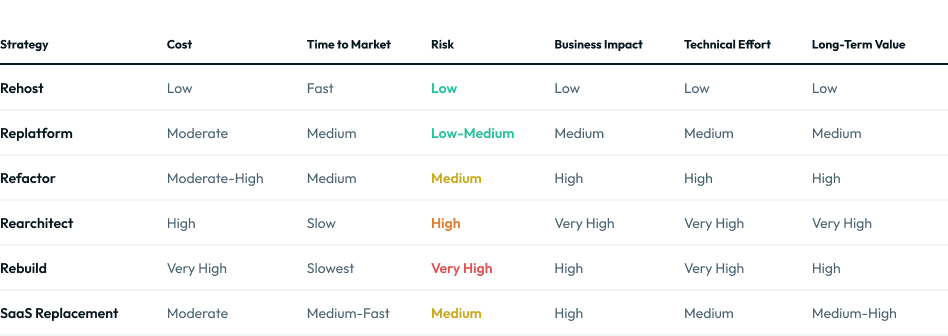
The important takeaway is that modernization is not a maturity ladder. Rehosting is not "worse" than rearchitecting. The right strategy depends entirely on business objectives and context.
Strategic Recommendations for Successful Modernization
Start with Business Capabilities, Not Applications
Instead of asking which applications need modernization, identify which business capabilities drive revenue, customer satisfaction, or operational efficiency. Modernization priorities become much clearer when viewed through a business lens.
Prioritize Business Value and Technical Debt Together
Not every legacy application deserves modernization.
Applications can be categorized into four groups:
- High business value / High technical debt
- High business value / Low technical debt
- Low business value / High technical debt
- Low business value / Low technical debt
Applications with high business value and high technical debt often provide the strongest return on modernization investments.
Modernize Incrementally
Large-scale rewrites are attractive in theory but risky in practice. Most successful modernization programs deliver value through a series of smaller, measurable improvements.
Use the Strangler Fig Pattern for High-Risk Systems
For critical systems, gradual replacement is often safer than complete replacement. New functionality can be introduced alongside the existing system and expanded over time, reducing business risk.
Adopt API-First Thinking
Modern applications rarely operate in isolation. APIs create flexibility, simplify integration, and reduce future modernization challenges. API-first thinking also creates opportunities for future reuse and partner integration.
Give Data Modernization Equal Attention
Data migration often becomes the largest source of project delays.
Application modernization plans should include dedicated data modernization strategies, governance models, and migration roadmaps.
Treating data as an afterthought is a costly mistake.
Establish Clear Success Metrics
Modernization should produce measurable results.
Examples include:
- Reduced operational costs
- Faster release cycles
- Improved system availability
- Lower defect rates
- Increased developer productivity
- Improved customer experience
Build Security and Observability into the Roadmap
Security, compliance, monitoring, and operational visibility should not be treated as post-modernization activities. They should be part of the design from the beginning.
Common Mistakes to Avoid
Over the years, I've seen several recurring issues:
Treating Every Application the Same
Not every application deserves the same level of investment. A customer portal and an internal reporting system should not receive identical treatment.
Business criticality matters.
Assuming Cloud Migration Equals Modernization
Moving a legacy application to the cloud may improve infrastructure, but it does not automatically improve architecture, maintainability, or delivery speed.
Rebuilding Without a Business Case
A complete rebuild should be justified by measurable business outcomes, not dissatisfaction with old technology.
Ignoring Organizational Readiness
Modern architectures require new operating models, skills, governance, and processes.
Technology changes alone do not create transformation.
Underestimating Data Migration
Data complexity frequently becomes the biggest source of project delays and risk.
Failing to Define Success
If success metrics are not established at the start, organizations struggle to demonstrate value at the end.
A Practical Modernization Decision Framework
When evaluating any application, technology leaders should ask:
Business Value
- Does this application create a competitive advantage?
- Is it core to customer experience?
- Does it directly support revenue generation?
Technical Health
- Is technical debt slowing delivery?
- Are maintenance costs increasing?
- Are critical skills becoming difficult to find?
Market Alternatives
- Are mature SaaS solutions available?
- Is custom development still justified?
Financial Considerations
- What is the modernization cost?
- What is the ongoing maintenance cost?
- What ROI can realistically be achieved?
Risk Assessment
- What security risks exist today?
- What operational risks exist if nothing changes?
- What business opportunities are being delayed?
The answers often reveal the most appropriate modernization strategy.
Looking Ahead
Several trends are reshaping modernization initiatives.
AI-assisted code analysis is helping teams understand decades-old applications faster than traditional documentation efforts.
Generative AI is accelerating code conversion, documentation generation, test creation, and impact analysis.
Cloud-native platforms continue to improve scalability and operational efficiency.
Platform engineering is reducing developer friction and improving consistency across modernization programs.
Event-driven architectures are helping organizations decouple systems and respond more effectively to changing business requirements.
These capabilities will accelerate modernization efforts, but they will not eliminate the need for sound architectural decisions and strong business alignment.
Final Thought
After participating in numerous modernization programs, one lesson stands out:
The goal is not to modernize every application. The goal is to modernize the capabilities that matter most to the business.
Organizations that focus solely on technology often end up spending more and achieving less. Organizations that connect modernization decisions to business outcomes, customer value, operational efficiency, and future growth consistently achieve better results.
Technology leaders should stop asking, "How do we modernize this application?" and start asking, "What is the most effective way to enable the business capability this application supports?"
That shift in perspective often determines whether modernization becomes a costly IT project or a genuine business transformation initiative.
How is your organization prioritizing modernization investments today: based on technical debt, business value, or a combination of both?