




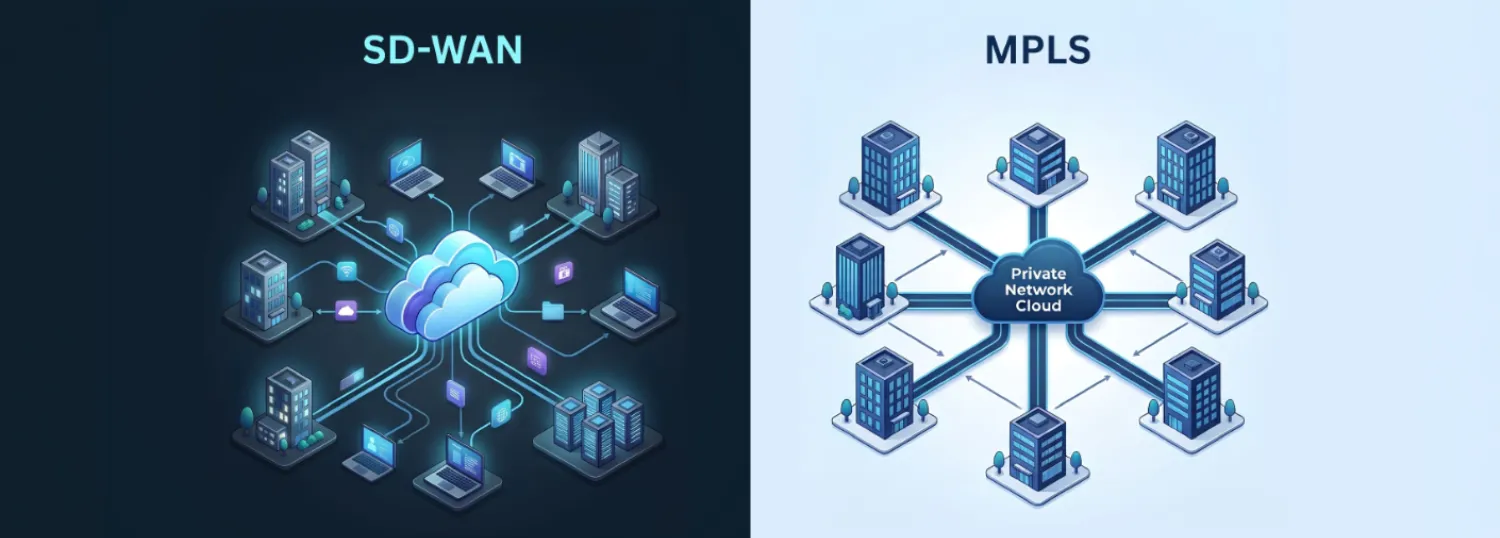
Every distributed business hits the same decision eventually: how to connect regional offices, a hybrid workforce, and a growing list of cloud applications without the network becoming the bottleneck. MPLS and SD-WAN are the two paths that come up most often, and the debate usually centers on cost and speed.
It rarely covers a bigger question: who runs the network once you switch? With MPLS, your telecom provider builds the circuits, monitors them, and picks up the phone when something breaks. With SD-WAN, costs drop and new offices come online faster, but the job of running the network moves to you.
That’s why the honest answer isn’t that one technology wins. Neither is automatically right for every company. The right choice depends on your budget, the applications your teams actually use, where the business is headed over the next few years, and who will own the network day to day. Here’s the comparison in plain terms, written for business leaders and IT teams working through the decision together.
What MPLS and SD-WAN Actually Are
MPLS
MPLS, or Multiprotocol Label Switching, is a private circuit a telecom provider builds and manages for your company alone. Because traffic moves over a dedicated, predetermined path rather than the open internet, performance stays consistent and latency stays low. That reliability comes at a cost: MPLS circuits are expensive, adding a new site can take weeks of coordination with the provider, and you are tied to that provider's infrastructure for as long as the circuit is in place.
The trade-off is straightforward: strong security and steady performance for critical applications, in exchange for a higher price and slower expansion.
SD-WAN
SD-WAN, or Software-Defined Wide Area Network, takes a different approach. Rather than depending on one private line, it manages several connections at once, broadband, fiber, 5G, LTE, and MPLS where it still exists, and routes each application over whichever path suits it best at that moment.
That gives most businesses lower connectivity costs, faster deployment at new sites, and a single dashboard for managing the whole network.
Because SD-WAN typically runs over public internet connections, day-to-day performance depends in part on the quality of the underlying internet service at each site.
How the Two Compare in Practice
Cost and scalability
MPLS pricing climbs quickly once you add branch offices, since every new site means another managed circuit. Businesses adding locations at any pace tend to feel this in the budget within a year or two.
SD-WAN keeps costs down by running primarily over standard internet connections instead of dedicated circuits, which is why it tends to win on cost for growing companies that still need the network to perform well.
Performance and applications
MPLS still makes sense for an organization whose applications sit in one centralized, on-premises data center and need the most predictable latency available.
For a team whose work increasingly runs through Microsoft 365, Salesforce, AWS, or Azure, SD-WAN's application-level routing sends that traffic directly where it needs to go instead of funneling everything back through a central office first.
Cloud readiness
Most businesses have moved a large share of their workloads to the cloud, and MPLS was not built with that shift in mind. Cloud-bound traffic on an MPLS network often still gets routed through headquarters before it reaches its destination, adding delay for no real benefit. SD-WAN was designed for this environment from the outset, giving each branch a direct, secured path to the internet instead of an unnecessary detour.
Security
MPLS earned its security reputation from being a private circuit, and that reputation is fair. Modern SD-WAN has closed most of the gap by encrypting traffic across public networks and pairing with frameworks such as SASE (Secure Access Service Edge). Properly configured, either technology can meet a strict security bar.
Flexibility and agility
Bringing a new site onto MPLS usually means weeks or months of coordination with the telecom provider. SD-WAN deployments are often handled remotely from a central dashboard, which can bring a new branch online in a fraction of that time, though the exact timeline depends on the vendor and the site.
When MPLS Still Makes Sense
MPLS has not disappeared, and for some organizations it remains the right call. It is worth keeping if your business fits one or more of these situations.
- You operate in a financial institution, government agency, or healthcare network with strict compliance and regulatory requirements.
- Your core applications still run entirely on local, on-premises servers rather than in the cloud.
- Guaranteed service levels and predictable performance matter enough to your organization to justify the higher cost.
When SD-WAN Makes the Most Sense
SD-WAN is increasingly a common choice for modern enterprises, particularly those further along in digital transformation. It is worth considering seriously if your business fits one or more of these situations.
- Your workforce is spread across retail locations, remote offices, or a hybrid setup.
- You are actively moving applications to the cloud, or have already moved most of them there.
- You need to bring new locations online quickly rather than waiting months for a telecom installation.
- Reducing network costs is a real priority for your IT budget this year.
A Hybrid Approach: Running Both Together
For many organizations, this is not a strict either-or decision.
A common pattern is a hybrid WAN: keep a smaller MPLS connection for the handful of workloads that genuinely need guaranteed performance, run everyday traffic over standard broadband and internet connections, and let SD-WAN sit on top, managing and steering all of it together.
That combination gives a business the reliability of a private network where it matters most, without paying for it everywhere it does not.
Making the Call
The more useful question is not whether to buy MPLS or SD-WAN.
It is which setup actually supports where the business is going over the next three to five years, and who will run it.
An organization tied to a data center and built around rigid, predictable performance will still get real value from MPLS. An organization whose future runs through the cloud, a distributed workforce, and fast growth will typically get more value from SD-WAN or a well-designed hybrid approach.
Covalience helps distributed businesses plan, set up, and manage networks like this. If you’re weighing the decision or approaching a contract renewal, we’re glad to be a second set of eyes.