



Technical debt is often treated as something engineering teams discover through code reviews, static analysis, architecture assessments, or a backlog of refactoring work. Those methods have value, but they can miss some of the most expensive debt in a complex system.
A system can have clean code, strong test coverage, modern frameworks, and few static analysis warnings, yet still be painfully expensive to change.
The real cost of technical debt is the total burden the system creates every time the organization needs to change it.
Technical debt is not the same as bad code
Consider two systems. System A is 15 years old, with duplicated code, legacy frameworks, limited documentation, and a few workarounds. Yet most changes can be made within one or two well-understood areas. Tests are reliable, deployments are automated, and incidents are rare.
System B uses modern microservices, strong test coverage, Kubernetes, CI/CD, and modern observability. Yet a small pricing change requires changes across multiple services, a database migration, data pipeline updates, regression testing, security validation, business validation, several participating teams, and a coordinated release.
System B may have considerably more technical debt — not because its code is worse, but because the total burden of making a change is much higher.
Coordination is not automatically overhead. If several teams participate because each owns an important capability affected by the change, that participation may be completely justified. The question is why the change requires this level of participation, dependency, validation, and effort.
Code quality is one input into technical debt. The burden imposed on future change is the outcome we experience.
What is the Total Change Burden?
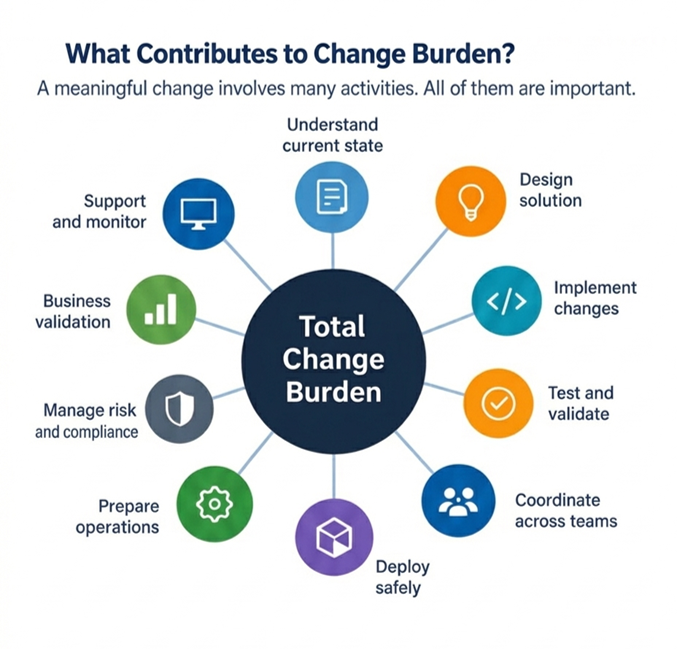
Total Change Burden includes every activity required to safely deliver the outcome. That can include understanding the current state, clarifying the requirement, designing the solution, implementation, data changes, security and compliance, testing, integration and business validation, coordination, deployment, monitoring, operational readiness, rollback planning, and support.
Every one of these activities may be important. The point is not to eliminate them. The point is to understand why they are required and how the burden evolves over time.
Total Change Burden = Everything required to safely deliver the change
Look at the system's change surface
A small business change can have a surprisingly large change surface. Consider a customer pricing change. It may affect the customer application, API gateway, pricing service, customer service, shared database, data pipeline, warehouse, reporting, finance system, and an external partner.
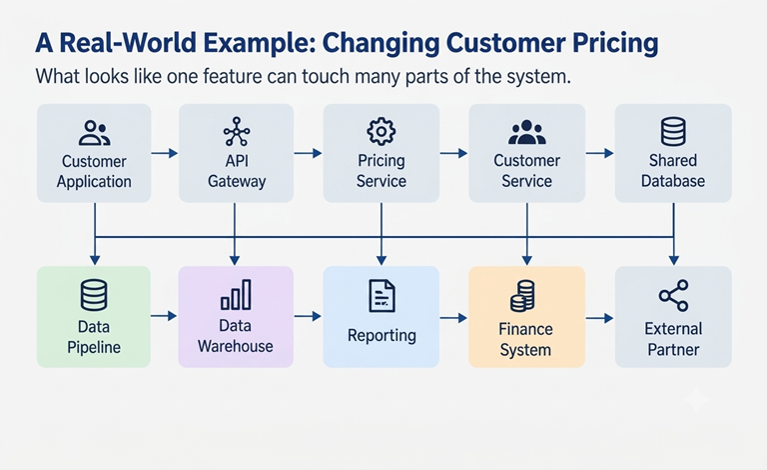
That is not automatically a problem. Pricing genuinely may affect finance, reporting, customer experience, and downstream integrations. The signal is when a relatively small change consistently creates a surprisingly large change surface because rules are duplicated, systems are tightly coupled, data is shared, or dependencies have accumulated.
Component count alone tells us very little. A system with 100 services may be easier to change than one with 10. What matters is how many systems, capabilities, dependencies, controls, and stakeholders participate in a typical change.
Use change history as evidence
Architecture diagrams show structural relationships. Delivery history can reveal how the architecture actually behaves.
- Which changes repeatedly involve the same systems?
- Which changes repeatedly require extensive validation?
- Which changes require several areas of the organization to participate?
- Which changes regularly require manual intervention?
- Which changes have a larger production impact than expected?
Measure coupling through change patterns
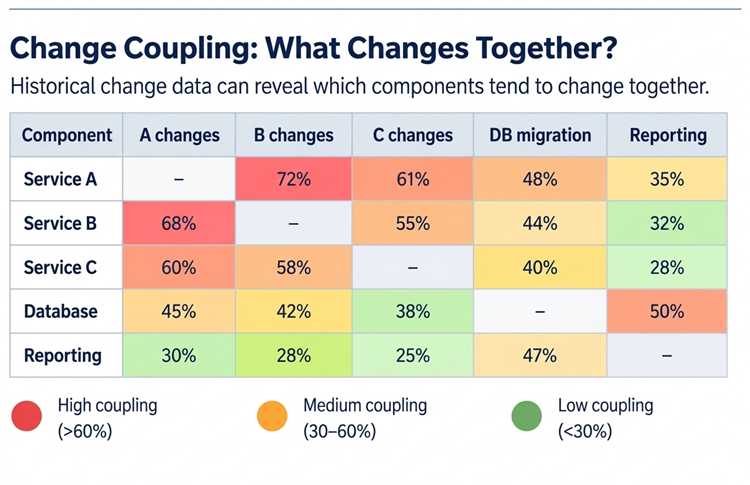
Historical change data can reveal temporal coupling. If Service B changes alongside Service A 72% of the time., Service C in 61%, database migration in 48%, and reporting validation in 35%, those components may behave like one change domain even if the architecture diagram shows them as separate.
Shared databases are a classic example. Independently deployed services can still be tightly connected from a change perspective when a schema change requires multiple teams to understand impact, update applications, test changes, and validate downstream behavior.
Other places hidden debt appears
Knowledge debt
Some technical debt lives in people's heads. Ask who understands the system, who can safely modify it, who understands the business rules, and what happens when those people are unavailable. If critical changes depend on one or two experts, the system has a resilience problem.
Testing and deployment
Coverage is useful, but it does not tell us how much of the system must participate when something changes. Look at the breadth of testing, business validation, production verification, manual deployment, environment differences, coordinated releases, rollback difficulty, and production-only configuration.
The better question is how much effort and risk it takes to safely put a change into production.
Data and APIs
Multiple definitions of the same metric, duplicate customer definitions, undocumented transformations, fragile pipelines, unclear ownership, manual reconciliation, and business logic embedded in reports can create enormous change burden. APIs create similar problems through unknown consumers, undocumented behavior, breaking changes, excessive versioning, and synchronous dependency chains.
Unknown dependencies increase both the burden and the uncertainty of change.
Think about principal and interest
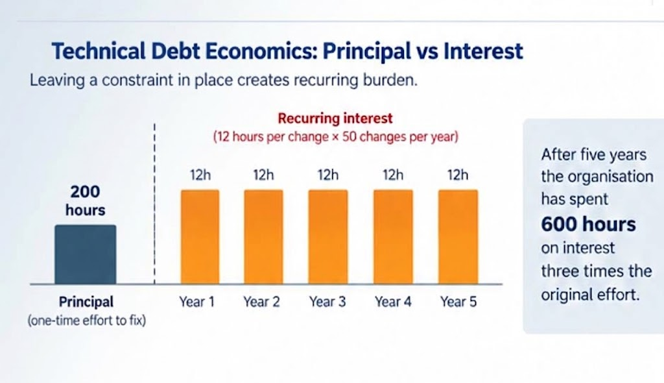
Principal is the effort required to remove an underlying constraint. Interest is the recurring burden created by leaving it in place.
Imagine that replacing a legacy integration requires 200 engineering hours. That is the principal. If every feature involving it adds another 12 hours, and this happens 50 times a year, the organization incurs 600 hours of recurring annual burden.
The architecture decision becomes an economic decision: What are we paying every year by choosing not to address this?
Prioritize technical debt by business impact
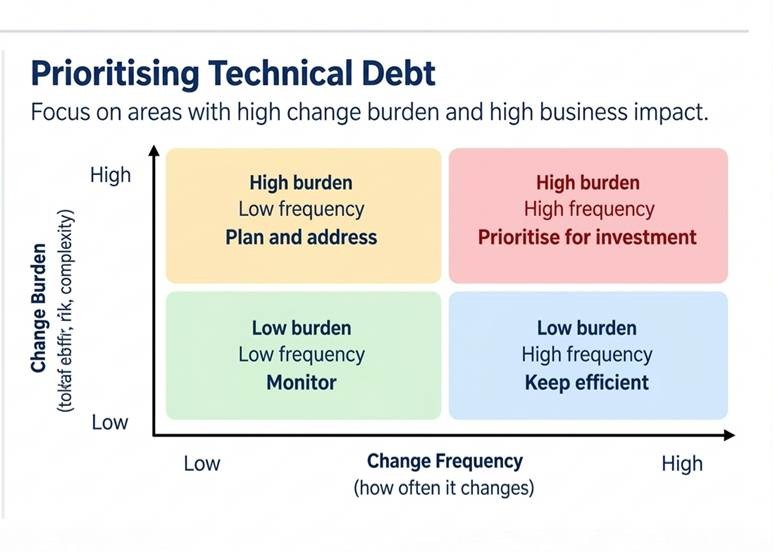
Not every technical constraint deserves immediate remediation. A practical model is:
Debt Priority = Change Frequency × Change Burden × Business Criticality
Score each factor from 1 to 5. A component with poor code quality that changes once every two years may deserve less attention than a reasonably clean component involved in almost every major product change and requiring extensive validation.
The strongest remediation candidates are the areas where high change frequency meets high change burden and high business importance.
A practical way to discover hidden debt
Start with the last 20 to 50 significant changes. For each change, capture:
- Understanding — How difficult was it to understand the current behavior?
- Design — How much architectural reasoning was required?
- Implementation — How many systems and components needed modification?
- Validation — How much testing and business validation was required?
- Participation — Which capabilities, teams, and stakeholders genuinely needed to participate?
- Deployment — How difficult was it to introduce the change safely?
- Operations — What monitoring, support, rollback, or production readiness was required?
- Risk — What could go wrong and what would be the impact?
Then look for patterns. You will often discover that a relatively small part of the architecture creates a disproportionate amount of change burden.
The metric that matters most
Are we making the effort, dependencies, and risks behind each change visible enough to make better architectural and delivery decisions?
Useful indicators to track over time include:
- Decision-to-production lead time
- Total engineering and analysis effort
- Testing and validation effort
- Number of affected systems and capabilities
- Legitimate participating teams
- Deployment complexity
- Change failure and rollback frequency
- Time to diagnose problems
If functionality grows while change burden remains stable or improves, the architecture is absorbing complexity well. If functionality grows while the burden of change steadily increases, technical debt is accumulating.
The goal is not zero technical debt
Technical debt is not inherently bad. A startup may deliberately choose a simpler architecture because speed matters more at that stage. An enterprise may accept some coupling because a business process genuinely requires it. A regulated system may require additional validation because the risk justifies it.
The goal is not to eliminate every source of complexity. The goal is to understand the burden that complexity creates and make conscious decisions about it.
- How clear is the impact of a change across systems, capabilities, and dependencies?
- Which components, teams, or dependencies repeatedly participate in the same changes?
- Where do unknown consumers, hidden dependencies, or concentrated knowledge increase change risk?
- How much validation, operational preparation, and rollback planning are required before release?
- Is the burden of change growing faster than the value the system delivers?
Conclusion
The most dangerous technical debt is not always ugly code; it is the accumulated burden created by architecture, data, dependencies, processes, and knowledge gaps that make future changes harder.
The key question is whether the effort required to deliver change is necessary, visible, and justified by the value and risk of that change.
Technical debt is the accumulated burden that a system places on every future change.
A healthy architecture keeps change clear, safe, and predictable as the business evolves.