


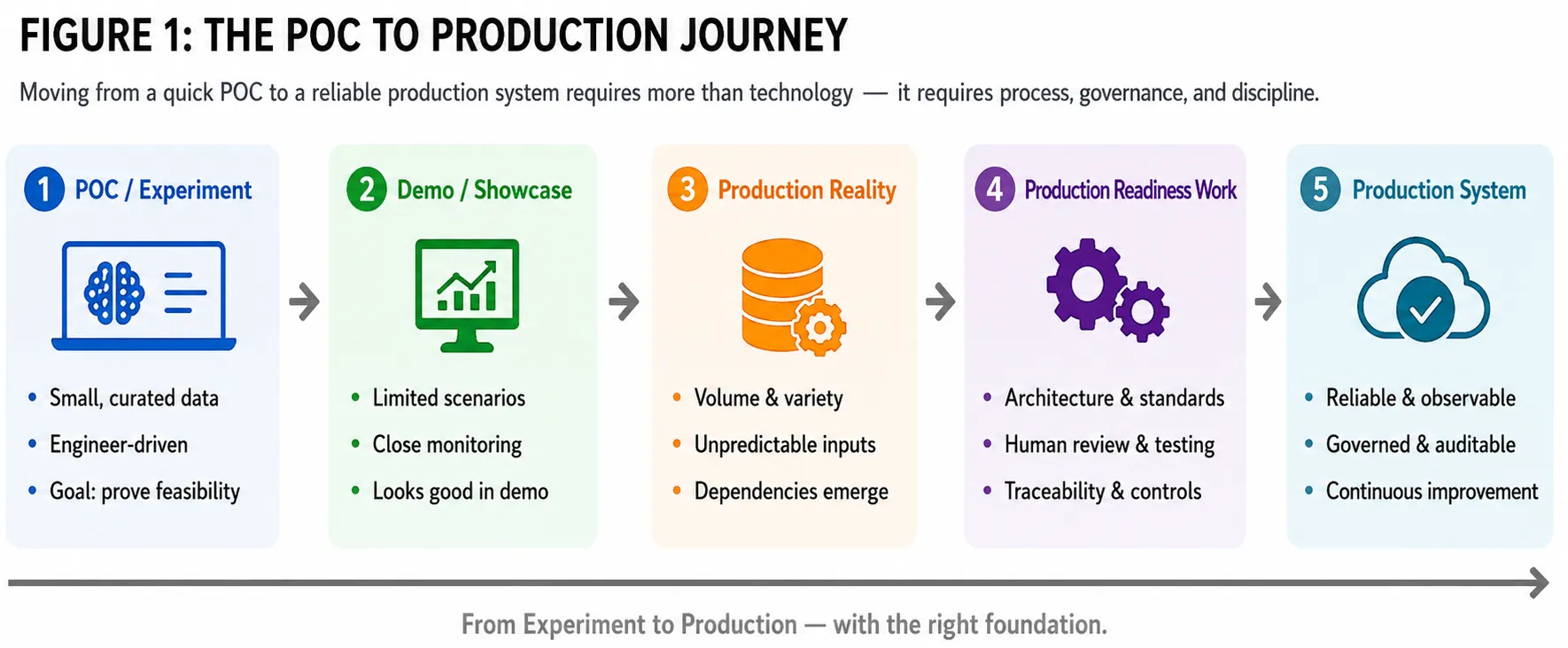
Our agentic AI proof of concept (POC) took a few days to build. When we showcased it to a group of leads, the first reaction was: "When can we roll this out?" The honest answer was weeks away, and this article is about what filled those weeks.
A POC runs on curated inputs and is usually watched closely by the engineers who built it. Production changes that environment. Data arrives in greater volume and with more variation, and the system has to operate reliably without relying on one engineer's knowledge of every prompt, pipeline step, and edge case
Many agentic AI projects stall in the gap between proof of concept and production. S&P Global Market Intelligence's 2025 Voice of the Enterprise research found that organizations reported scrapping an average of 46% of their AI projects between proof of concept and broad adoption. For agentic systems specifically, Gartner predicted in June 2025 that more than 40% of projects would be canceled by the end of 2027, citing escalating costs, unclear business value, and inadequate risk controls.
The Failure Is Silent: What Our Own System Taught Us
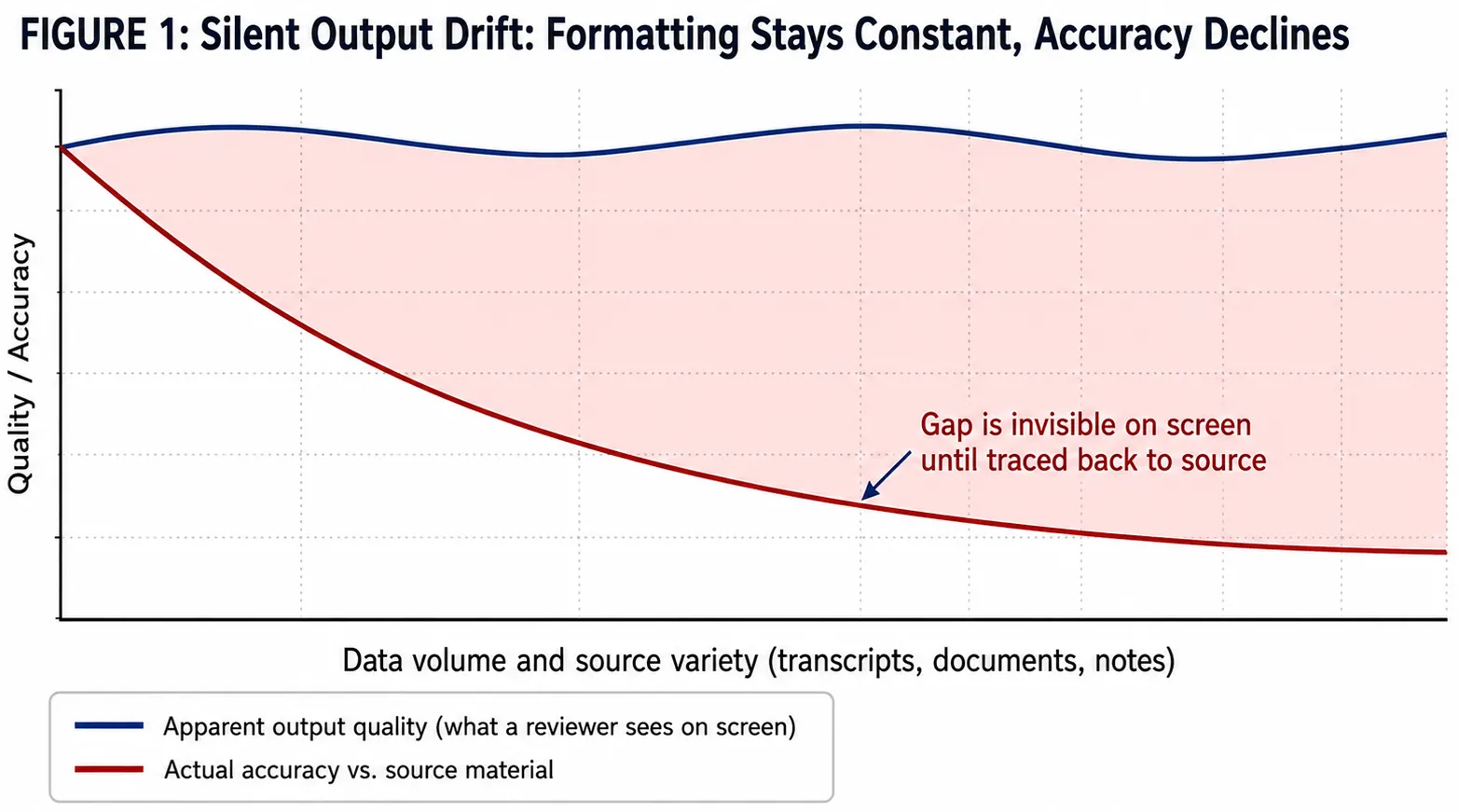
One of the production risks that caught us out was silent loss of grounding: output that remained well-formed and plausible while gradually diverging from the source material it was supposed to represent
At POC scale, with a handful of inputs, the outputs held up. The trouble started when we increased both the volume and variety of the data: transcripts, documents, and notes with different structures and levels of detail. As the pipeline processed more source material, errors and omissions in earlier stages could carry forward into later stages, where they were treated as input rather than questioned. The resulting output still looked well-structured and plausible, but it was becoming less reliably grounded in what the source material actually said. Nothing crashed. No error appeared. The quality of the formatting stayed constant while the accuracy of the content quietly declined.
That experience reframed the whole production question for us. If the system had failed loudly, we would have fixed a bug and moved on. Because it failed silently, we had to accept a harder conclusion: an agentic system headed for production needs verification, traceability and human checkpoints designed into it, because no one will notice the moment it starts being wrong. The seven practices below are what we put in place as a result.
The Production Playbook for Agentic AI Systems
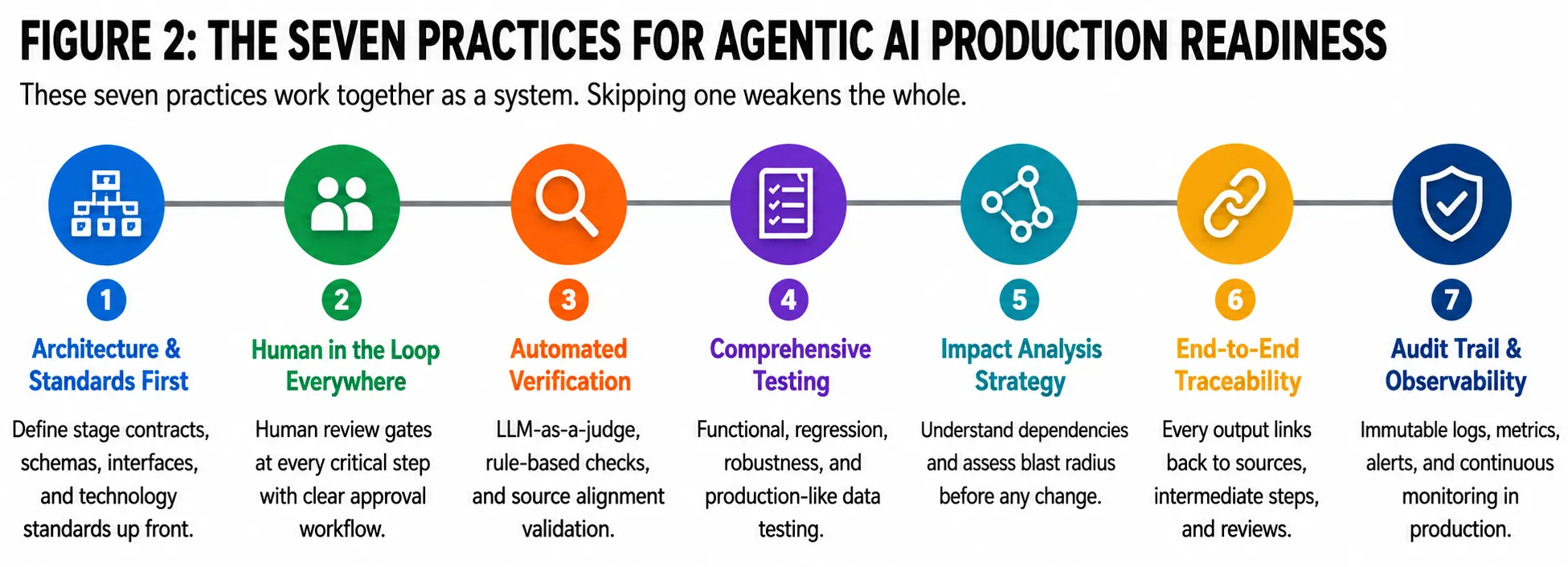
Production readiness for an agentic system comes from seven practices working together. Some prevent errors from propagating, some make problems visible, and others provide the structure needed to investigate and manage changes safely. Several also align with the practices in NIST's Generative AI Profile, the U.S. standards body's risk management guidance for generative AI systems. Here is each practice, and how we actually implemented it.
Define the Architecture and Technology Standards First
A POC built in a few days is optimized to prove that the idea works. Production requires a structure that makes the system predictable, testable, and changeable. Before any production work started, we defined the system architecture and the technology standards it would be built on. In practice this meant treating each pipeline stage (ingestion, summarization, requirement extraction, backlog generation) as a contract: a defined input schema, a defined output schema, and validation at the boundary so a malformed output from one stage stays contained there. We abstracted model and provider choices behind an interface, so a model swap stays local to that interface.
This step feels slow when the demo already works, which is exactly why teams skip it. Every other practice in this playbook attaches to this structure. Tracing an output needs a mapped pipeline, and assessing the blast radius of a change needs boundaries that exist somewhere other than one engineer's head.
Put a Human in the Loop at Every Critical Step
In an agentic pipeline, an error made early travels. A misread transcript becomes a wrong summary, the wrong summary becomes a wrong requirement, and the wrong requirement becomes a sprint of wasted work. Because the output can remain plausible even when it is wrong, downstream stages have no reliable way to detect that their input is bad..
Architecturally, this is a review gate. Each artifact carries a status field (generated, pending review, approved), and the next stage only consumes artifacts marked approved. A stage's queue holds until the required review is complete, and that action is recorded against the artifact. We apply mandatory human review at critical points where an incorrect output could materially affect downstream work; lower-risk outputs can instead be prioritized through automated verification and sampling. This keeps human review focused where it has the greatest impact without making every stage dependent on manual approval.
Build an Impact Analysis Strategy Before You Change Anything
Agentic systems are webs of prompts, pipeline stages and data dependencies, where a change in one place can alter behavior somewhere that looks unrelated. We saw this directly: a change to a single requirement in a generated SRS propagated into downstream requirements and user stories, altering the scope of the work that had already been generated. What looked like a local modification had affected the wider system of artifacts built on top of it.
This requires a dependency graph that tracks which downstream artifacts came from which upstream ones: a user story traces back to a requirement, which traces back to an SRS section. Before a change ships, we walk that graph outward from the change point, re-run the affected downstream artifacts, and compare the new output against the previous version. The resulting differences are reviewed to confirm that expected changes have propagated correctly and that unrelated requirements or artifacts have not changed unexpectedly.
Define End-to-End Testing Use Cases
Testing each component in isolation misses how an agentic system actually fails. Each stage of our pipeline could produce reasonable output on its own while the end-to-end result still drifted from the source material, because small inaccuracies compound as they pass from stage to stage.
We maintain a golden dataset: a fixed set of representative inputs, such as a transcript or document bundle, paired with the expected characteristics of the resulting output. Each test runs the complete pipeline rather than testing individual stages in isolation. Because generative output varies between runs, we compare results against the expected facts and requirements and check for unsupported claims or other deviations that require review. The suite reruns whenever a prompt, model, or pipeline stage changes.
Make Every Output Traceable to Its Source
When output quality is in question, a reviewer's first need is knowing where a generated statement came from. Without that, verifying a single user story means re-reading every transcript and document the system ingested, and verification at that cost stops happening.
We built traceability by carrying a source reference (a document ID plus the specific passage or span) alongside every generated claim. A reviewer can click from a generated requirement straight to the transcript passage it came from and confirm whether the system interpreted it correctly. Traceability turns verification into a quick comparison, making human review practical at the volume an agentic system can produce.
Confidence signals can help prioritize what gets reviewed first, but they are not treated as evidence of correctness. Running the same input multiple times can reveal where outputs disagree with themselves. The stronger check is source-based verification: each generated claim is compared against the source passage it cites to determine whether the claim is actually supported. Because that verifier is itself model-based, it should be validated against the golden dataset and periodically spot-checked through human review. This check slots directly into the traceability structure above, since the source reference is already attached to the generated claim.
Keep an Audit Trail of Every Change
Silent output drift raises a question most POCs cannot answer: when did the output start going wrong, and what changed around that time? We maintain an append-only log of every prompt revision, pipeline modification, and configuration change, with each entry tied to a timestamp, an author, and a snapshot of the artifacts generated around that point. When output quality shifts, the audit trail lets us line up the timeline of changes against the timeline of degraded output and investigate what changed. It also provides the documentation and provenance needed to understand how the system evolved over time.
Test Adversarially, Not Just the Happy Path
A POC is usually tested with the inputs it handles best, and it passes because of that. Production inputs will include the most difficult material your organization generates, and the system needs to face those cases before users do.
Alongside the golden dataset, we maintain a separate adversarial corpus: malformed transcripts, contradictory stakeholder notes, and incomplete documents, built deliberately to be difficult to parse. We use these cases to test how the system responds when its inputs are ambiguous, incomplete, or inconsistent. Does it surface uncertainty and degrade gracefully, or does it produce a confident answer that is not supported by the available evidence? We want to find that second behavior ourselves before users do.
How to Sequence the Transition
Seven practices is a lot to adopt at once, and they don't all need to come first. Based on our experience, the sequence looks like this.
Before any production code is written, define the architecture and technology standards, and design the human checkpoints into the pipeline. These two decisions shape everything downstream, and in our experience, retrofitting them after the system is built would have been significantly more disruptive than designing them in from the start.
While hardening the system, build the verification infrastructure: source traceability, the audit trail, and the end-to-end testing use cases. These three work as a set. The test cases tell you whether the system is behaving, traceability lets a human confirm why, and the audit trail tells you what changed when it stops behaving.
Two practices continue throughout the life of the system. Adversarial testing continues after launch because production keeps generating new kinds of difficult input. Impact analysis runs before every change because an innocent-looking edit can affect downstream artifacts and reshape project scope.