



Agentic AI behaves more like an autonomous digital worker than a traditional chatbot. It can plan, call APIs, query databases, and loop over its own reasoning before delivering an outcome. When that worker touches money, customer data, or production systems, you must be able to answer one question with confidence
“Why did the agent do that?”
If you cannot show the steps behind an agent’s decision, you don’t really control it.
From Straight Lines to Loops
Classic RAG pipelines tend to follow a straight line: a single question leads to one retrieval step and one answer. If something goes wrong, you can usually inspect that line from end-to-end.
Agentic systems, by contrast, behave more like graphs than lines. An agent can branch into different actions, loop over reasoning steps, revisit earlier state, or retry with new context. The final answer is the result of navigating a path through this graph, not walking a single predefined route.
Frameworks like LangGraph make this explicit by modeling workflows as stateful graphs with nodes (steps) and edges (transitions). This structure is powerful—but it also means bugs, policy violations, and data leaks can hide inside multi-step flows unless you observe and trace them carefully.
Observability, Tracing, and Traceability
Three ideas matter here:
- Observability: Seeing how your system behaves using logs, metrics, and traces including latency, errors, cost, and quality.
- Tracing: Capturing the full timeline of a request: each LLM call, each tool, each state change, with inputs and outputs attached.
- Traceability: Being able to reconstruct and explain a specific decision path for audits, investigations, or regulators.
In Agentic AI, observability tells you that something is wrong; tracing shows where it went wrong, and traceability lets you prove what happened.
Governance and Data Security
In many regulated domains, observability goes beyond reliability and becomes a governance requirement.
You need:
- Audit trails: Which tools were called, what data they saw, and what they returned.
- Access visibility: Which tables, APIs, or documents the agent touched, especially when personally identifiable information (PII) or financial data is involved.
- Policy evidence: A way to show that business rules and regulatory constraints were applied in the decision path.
If you cannot replay a problematic run and see exactly where policy, data, or logic went off track, you are flying blind.
LangGraph: Making Paths Predictable
LangGraph helps by forcing you to design agents as explicit graphs.
- Stateful graphs: Shared state is passed through nodes, updated in controlled ways, and visible at each step.
- Clear nodes and edges: Each node encodes some logic (LLM call or code), and edges decide what runs next; loops and branches are intentional, not accidental.
- Natural checkpoints: Every node is a good place to log state, validate constraints, or pause for a human review before continuing.
This makes agents more predictable and much easier to instrument.
LangSmith and Beyond: Seeing Inside Runs
On top of structured workflows, you need tools to inspect actual executions.
LangSmith is built for tracing LLM applications: it records every run, including prompts, model responses, tool calls, and evaluations. You can see:
- Full call trees for a request.
- Latency and token usage per step.
- Where errors, low scores, or bad outputs came from.
Open-source and commercial platforms like Arize Phoenix and others extend this with dashboards, drift detection, and alerts for agent behavior in production. Together, they turn opaque agent behavior into something you can monitor like any other critical service.
Human-in-the-Loop: Using Traces to Improve
Observability exists to give humans the context they need to make better decisions, especially when agents operate autonomously.
With good traces, human reviewers can:
- Inspect failed runs with full context instead of guessing from a screenshot.
- Adjust prompts, add guardrails, or change state transitions at the exact steps that cause issues.
- Curate “golden traces” of ideal behavior and reuse them as test cases or training data.
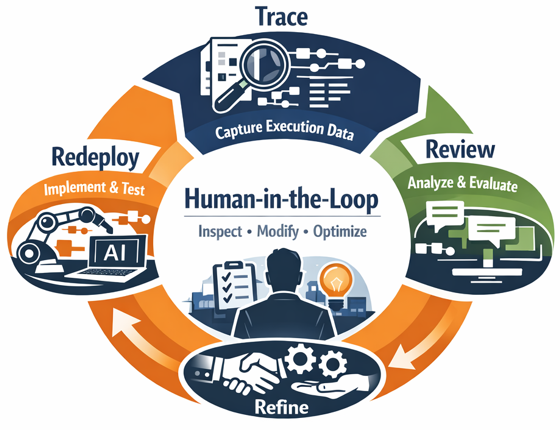
This creates a flywheel: trace → review → refine → redeploy, with humans steering how the agent evolves.
If You Can’t Trace It, Don’t Ship It
Agentic AI is moving from demos to critical workflows. The teams that succeed will be those that prioritize transparency alongside intelligence.
If you can explain, with evidence, how your agent reached a decision, what data it saw, and which rules it followed, you can earn trust. If you can’t trace it, you shouldn’t ship it.